

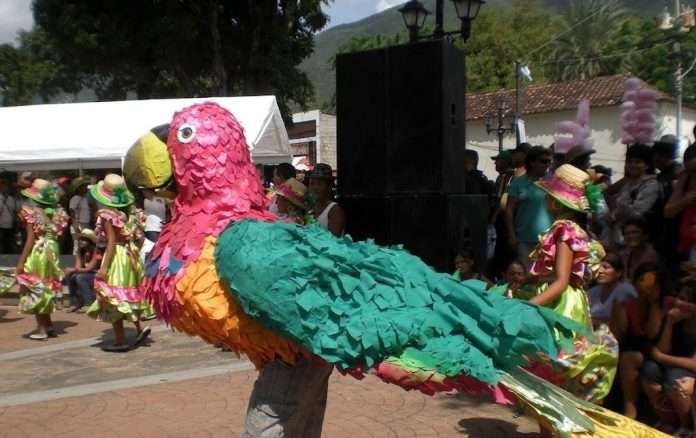
We're heading to eastern Venezuela, an untamed land that hasn't let anyone conquer it. That mix of Guaiquerí and Carib peoples has something special (and a certain kind of grit), and the Eastern Diversions have a lot to offer so we can finally learn that there's another story, legitimate and authentic, and one that continues to fight for its place, refusing to relinquish it to the orange-clad team, who seem oblivious to the fact that Rondón hasn't even had a chance to fight yet.
These historical entertainments are traditions that combine dance, theater, set design, costumes, and music.
Much joy in the eastern streets when they emerge in patron saint festivals and of the imposed Gregorian calendar, which is not from around here.
It will always have a central, symbolic (or synthetic) character, usually an animal from the region with which stories are developed that leave a lesson, always a lesson, and are profane (thank God).
The Guarandol bird: “Don’t kill it, no, hunter / for that is my Guarandol / that pecked the flower. I will cure that bird, hunter / with coconut oil and a stick of rum.”
The Carite: “Yesterday the Nueva Esparta boat set out / confidently to travel the seas and found a strong, very light fish / that breaks the hooks and bursts the lines.”
The Sebucán: “We are the Indians, the Indians of Pariaguán / who have come to dance this beautiful Sebucán. Here we are, the women, weaving this Sebucán / and if we make a mistake, it will be poorly woven.” This is without mentioning the unforgettable Mermaid of Cumaná, the eternal María Rodríguez.
My Uruguayan friend Ricardo Pose sent me a Uruguayan version of El Chiriguare, which is a marvel. Those who practice these ancestral traditions also eat, get sick, and take the bus. All this is relevant because these traditions are steeped in history, a great deal of history, and not the kind you find in books, just so you know.
To the good understanding...


