

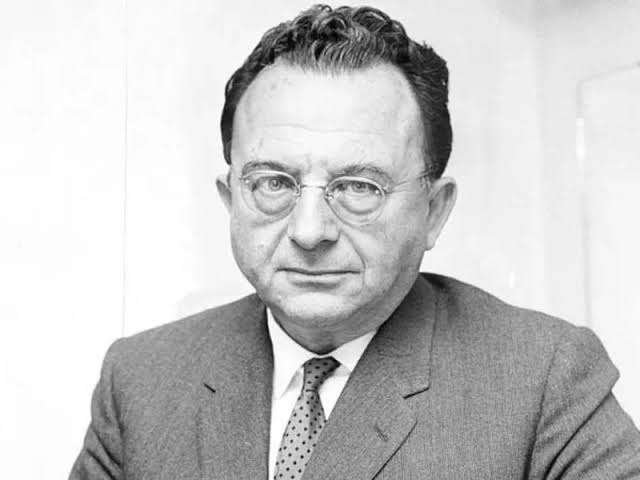
In 1949, while many were enjoying the musical comedy "Calabacitas tiernas", starring Germán Valdés, "Tin Tan"; and others were thrilled by "La oveja negra", starring Fernando Soler and Pedro Infante, a universal thinker arrived in Mexico.
Erich Fromm was setting foot on his territory. He arrived from the United States, pursued by powerful enemies of his critical and heterodox point of view.
The post-war political climate was tense in the northern nation. Paradoxically, the man who had fled his native Germany because of Nazism now found himself in the beautiful, beloved country spurred on by obscurantism. The witch hunt against Joseph McCarthy for his alleged communist affiliation would cost the Jewish intellectual his self-imposed exile.
The search for warmer climates to alleviate his wife's arthritic suffering led him to seek refuge elsewhere. The hot springs beckoned, and the National Autonomous University of Mexico welcomed him. There, he would eventually become professor emeritus. For over two decades, he would cultivate a fruitful teaching career, until 1973.
Fromm's presence would be felt at the Mexican Institute of Psychoanalysis, as well as in his profound studies of local indigenous communities. His work would also appear in important scientific journals. Once settled in his new home, he would establish relationships with Ivan Illich, Paulo Freire, and Daisetz Teitaro Suzuki, respectively.
The truth is that by the age of 50, Fromm was already living in Mexico. He resided at 9 Neptuno Street, Jardines de Cuernavaca. He had a practice and conducted fieldwork in various nearby towns. Ocotepec, Chiconcuac, Tepoztlán, among others, captured his keen attention.
There, five years later, he would publish his work "The Art of Loving," a book of undeniable value for any reader, whether specialist or layperson.
Fromm was a harsh critic of Sigmund Freud. In his view, the driving force of the unconscious was not only instincts, but also the material conditions of life. He was more interested in man in society than in the individual as an isolated entity.
Fromm, with his humanistic approach, masterfully delves into the premise that love is an art, being a practice - which rests on a capacity, faculty - susceptible to being cultivated and disseminated.
We remember Fromm's "The Art of Loving" as a great contribution from a scientist who managed to combine the principles of Marxism with psychoanalytic postulates to explain how "love is the only healthy and satisfactory answer to the problem of human existence."
How relevant the importance of affection remains in these times!
How much of the ancestral and orgiastic masochism and sadism that I would analyze at the time prevails, even with the most sophisticated means!
The self-destructive appetite is evident in an ultra-mediated society, full of "symbiotic relationships", personifications of things and objectifications of people!
Capitalism is undoubtedly more alienating than Erich Fromm would have surmised in the middle of the last century.
Are we still irresponsible, incapable of loving, caring, respecting, and knowing? Is it possible to be truly free?
Thus, "The Art of Loving," which is now in its seventh decade, would be written by a singular exile in Morelos, in the "homeland" of the immortal Emiliano Zapata.


I had the opportunity to read "The Art of Loving" by Erick Froom at the Pedagogical Institute of Caracas, assigned by Professor Boscán in 1981. I enjoyed it and it reinforced my convictions, that statement by Che Guevara when he told us in the sixties: "the revolutionary is moved by great feelings of love."