

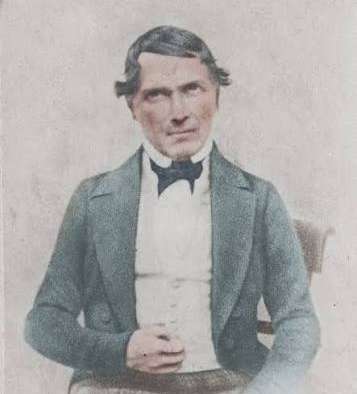
Any portrayal of Vicente Rocafuerte will always be controversial. This man from Guayaquil, born on May 1, 1783, and who died on May 16, 1847, is considered by historians to be a key figure in our founding war.
He would be a wealthy, educated, multilingual, and itinerant figure. As a renowned historian and journalist, as well as a political agitator, he would eventually become the first president of his country. As a liberal, he would support social and political reforms—public and compulsory education, textbooks, education for women, a medical school, a national museum, religious openness, a free press, transparent administration, an improved prison system, and the promotion of immigration, among others—considered progressive measures for his time.
However, despite his political advancement, Rocafuerte could not escape a certain elitism, which led him to build bridges with conservative and authoritarian sectors; an aspect that his biographers consider contradictory.
Rocafuerte would gradually jump from monarchism to republicanism, and with early Masonic leanings, would close his adult life embracing Protestantism.
Although he was a soldier, he did not fight on the battlefield, playing a more strategic role as a financier of the independence cause. He was a staunch adversary of Agustín de Iturbide, and was close to Lucas Alamán and Guadalupe Victoria, respectively.
Rocafuerte served as a Mexican diplomat in England, France, Denmark, and the Kingdom of Hanover with the endorsement of Friar Servando Teresa de Mier, eventually obtaining, like Simón Bolívar, citizenship in Mexico. An opponent and later an ally of Juan José Flores, he led a very active political life in his native Ecuador during the fourth decade of the 19th century.
We must emphasize that in his struggle for power, Rocafuerte was an enemy of Simón Bolívar; in this sense, let us recall his comments sent to the Secretary of Foreign Affairs of Mexico regarding the supposed "monarchical aspirations of the Liberator".
In a document dated September 18, 1828, and described as “top secret,” Rocafuerte states unequivocally that the man from Caracas is negotiating the fate of America in Madrid “as he has already sold those of Colombia,” and that he also longs to acquire Mexico “which is worth more than the rest of America and which he has always aspired to; he knows, in short, that he will lend a benign ear to any proposal that leads to crowning a prince of the royal family in Mexico; time has shown the government of Madrid the folly it committed in not having confirmed the Treaty of Iguala.”
Rocafuerte continued to assert that "Bolívar has taken off the mask of patriotism, and is capable of anything."
“Delusional,” “ambitious,” and “Machiavellian” are some of the epithets Rocafuerte used to discredit the Liberator. An alleged truce between Spain and Colombia, harassment by the northern country instigated by the Venezuelan landowner, and the intention to invade Mexico led Rocafuerte to advise neutralizing Bolívar, “who aspires to exhaust the people through disorder, anarchy, and misfortunes in order to more easily bind them to the chariot of his absolute or monarchical power.”
Vicente Rocafuerte thus found himself among the slanderers of the solar leader, joining those types who could not stand the unionist zeal of the Man of Difficulties.


One thing all Venezuelans are very sure of is that the Liberator never spoke ill of another person, because he was very direct and clear. All those detractors of Simón Bolívar have passed into oblivion, while his legacy endures through the time of the people and in the minds of revolutionary men.
Francys Emilio Romero Aguilar
Professor Alexander Torres Iriarte, along with the barrage of slander, lies, and false testimonies leveled against that real-life figure, Simón Bolívar, we also find praise tinged with flattery. And it seems that such figures, particularly influential ones in the historical context, like Bolívar, abound, enough to warrant exploring a psychographic analysis of the man of hardship, or the Liberator. Indeed, this latter title is well-deserved by this tireless fighter. "Disillusioned and betrayed, his desire was to withdraw from the supreme command of Colombia," Armando Rojas reminds us in "BOLÍVAR'S QUIXOTISM." Perhaps this reflects his selfless nature and singular temperament. Let us read Rojas's reference: "My honor and my glory demand this act of absolute detachment so that the world may see that in Colombia there are men who despise power, supreme power, and prefer glory to ambition," he wrote to General Páez on December 12, 1829.
What sadness, what a contradiction for a man from a sunny age, to envy and want to replace the father of the Americas.
Simon Bolivar, the Liberator of the Americas:
Latin America and the Caribbean region