


In the context of the political crisis and violence suffered by Haiti, from which the denunciation of at least 2.796 murders in 2022 derives, dozens of protesters today demanded in Port-au-Prince, the capital of the Caribbean nation, the cessation of mass deportations of their compatriots from the neighboring Dominican Republic.
The demonstrators protested in front of the Dominican Republic consulate in the Haitian capital, where they denounced the violence inflicted by Dominican authorities on Haitian women and children when they return them, without legal mediation, to their country. They repudiated that the practice of the Executive chaired by Luis Abinader has a racist and discriminatory nature.
It is worth noting that according to data from the Support Group for Refugees and Returnees that coincide with statements by the general coordinator of the Haitian National Migration Office, Jean Negot Bonheur Delva, more than 50.000 Haitian migrants were expelled from the Dominican Republic in three months, and at fewer than 1.000 were unaccompanied children.
Already on November 11, Volker Türk, United Nations High Commissioner for Human Rights, asked the Dominican Republic to suspend the deportations of Haitian migrants, given the situation of chaos, violence and political crisis in its neighbor.
“The incessant armed violence and systematic violations of human rights in Haiti do not currently allow for the safe, dignified and sustainable return of Haitians to the country,” Türk said in a statement and called for the same consideration from other countries, including the United States, where the government of Joseph Biden has imposed special repression against migrants since the beginning of the crisis in Haiti.
They compare Abinader with Trujillo
In a statement from the Assembly of the Peoples of the Caribbean (APC) read during the protest in front of the Dominican consulate in the Haitian capital, the professor and economist Camille Chalmers demanded an end to the mass deportations ordered by the government of President Luis Abinader, to who accused the military of ordering inhumane treatment against those who are deported.
Chalmers blamed President Abinader for the violence and assured that he remembers the actions of the dictator Rafael Leónidas Trujillo (1891-1961) against poor populations of the two nations that share the island of Hispaniola.
The APC text points out that the practice of mass deportations does not respect the principles of coexistence and good neighborliness between both countries and peoples, and questions that the operations are carried out against people whose only sin is living in an irregular situation in Dominican territory, he stressed Telesur.
Chalmers, who is also a spokesperson for the Rasin Kan Pep La party, urged the Dominican government to use dialogue based on respect to find solutions to the migration crisis and assured that racism, discrimination, xenophobia and hatred towards Haitians they will never be able to solve that crisis.
It also demanded that the Dominican authorities respect international conventions, as well as the principles of respect for human rights of the Constitution of that country.
Violence leaves thousands dead this year
Colectivo Défenser Plus, a Haitian organization for the defense of human rights, denounced that so far in 2022, 2.769 people have been murdered in the capital Port-au-Prince alone. The report occurs one year and four months after the political crisis and gang violence that broke out after the assassination of President Jovenel Moïse on July 7, 2021 at the hands of Colombian mercenaries.
Antonal Mortimé, coordinator of the Défenser Plus Collective, said that in the upsurge in crimes committed by armed groups, 85% of the victims died in shootouts and 25% from "knife attacks or mob violence." The shocking figure does not include victims who died in hospitals after the attacks, which increases the total number.
“On many occasions, corpses are seen lying around, while everyone continues with their activities; As if nothing had happened. As a result, what should have been considered tragic is considered normal," lamented Mortimé, quoted by Prensa Latina.
Reports show that armed groups control the northern and southern exits from the capital and clashes have caused at least 500 deaths since late April, hundreds of others have been injured and more than 30 have been forced to flee their homes.

Last week, the Episcopal Commission for Justice and Peace; which in the last two decades has kept a count of violent deaths, denounced that 863 people were killed with a firearm between January and November, and that 11 of that number were children. The entity admitted that the figure represents a very conservative estimate of the total number of victims.
The ghost of another UN mission
It is worth noting that currently the Executive continues to be headed by Prime Minister Ariel Henry, whom Moïse intended to dismiss, and that the violence of armed groups that control strategic areas of the nation is the excuse for not calling elections.
Last October, the Henry administration asked to deploy foreign troops to Haiti to control the gangs, a request that the US and Canadian governments were quick to second; who immediately sent vehicles, but which is widely repudiated by the ordinary Haitian people who remember the toll of abuse and rape they suffered at the hands of the soldiers sent by the UN, from whom they were supposed to receive protection. Several countries were reluctant to the option of a new mission in Haiti, and thousands of Haitians mobilized against a new intervention.
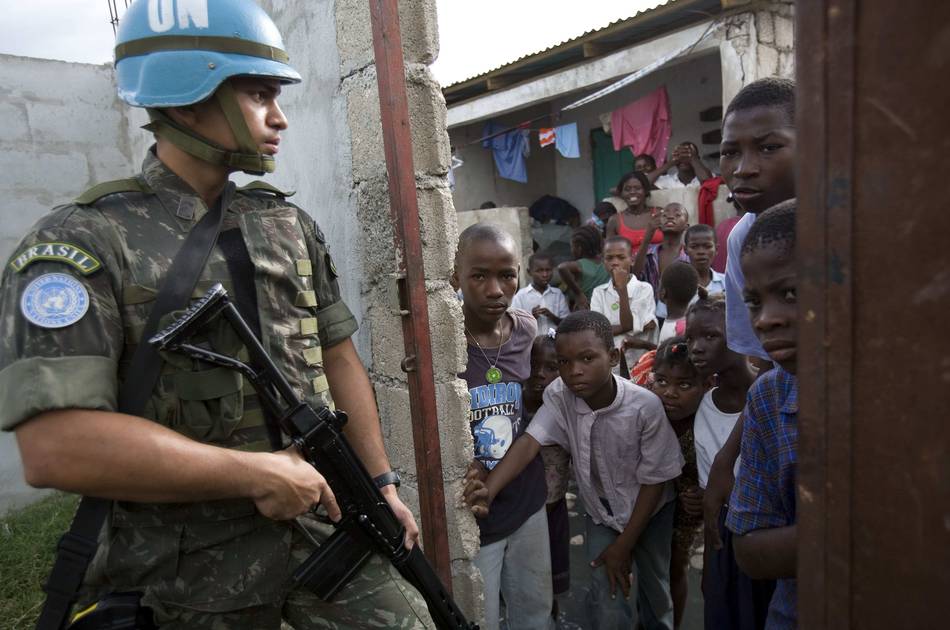
It is worth remembering the so-called MINUSTAH; a United Nations Peacekeeping mission that operated between 2004 and 2017, which, according to research by universities and human rights organizations, left a balance of more than 250 stories of children fathered by "blue helmets", as a euphemism for sexual violations by UN troops who were supposed to protect the population.


Another example of “looking the other way” by the Human Rights Commission and Western democratic countries.
The same scheme is repeated: it is not in Cuba, nor Venezuela, nor Nicaragua, nor Bolivia.