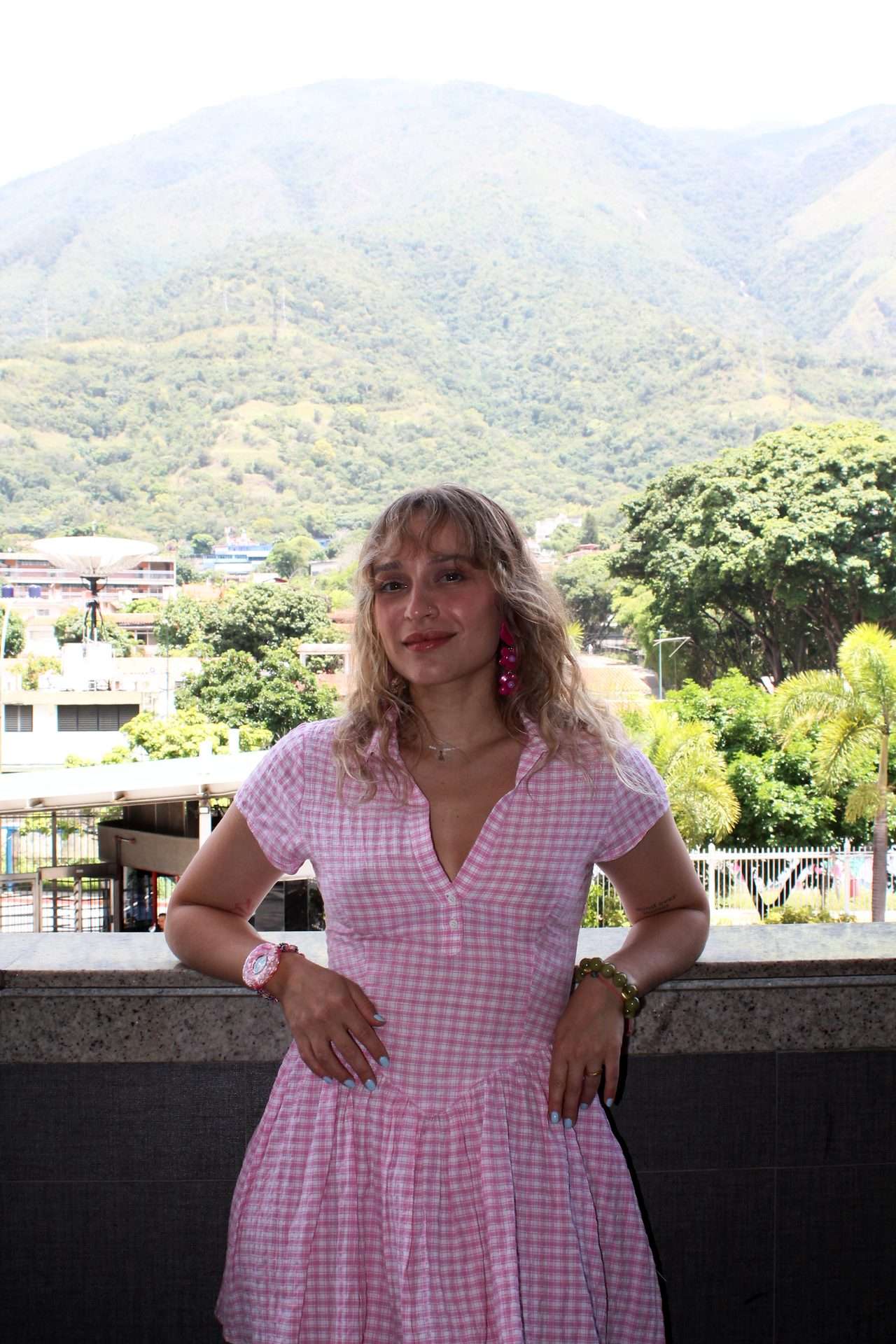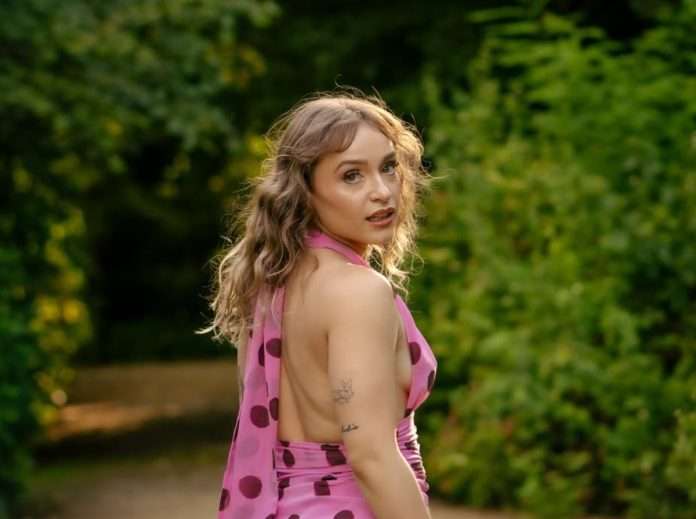
Lucía Alegría doesn't want to be just another artist abroad. She seeks to represent Venezuela, both in Spain, where she lives, and elsewhere, and to be part of building the country's music industry. That's why participating in the closing concert of Caracas Music Biz 360 last Saturday allowed her to move closer to that dream.
“It’s a pretty intimate, pretty vulnerable experience. I remember once a girl told me, ‘Going to see you is like going to therapy,’” the singer commented before the show. She describes her creative process as “an avalanche of emotions that will later transform into other things” and is currently preparing an EP.
—Was this your first visit to the country after the double earthquake in June?
—Yes, the reality is that it has been quite an emotional return, not only for that reason, but because I think the country is at a moment where it is also trying to rebuild itself, but very vulnerable, and experiencing that from the outside is one thing; I think those of us who live outside can never fully understand it.
You know, when you come back and find yourself facing that, I think you start to put a lot of things into perspective. (…) We have to reconfigure what normal means for each of us, and that's also a process of self-reflection. I always take those moments to reflect on my realities, the realities of the people around me here, and in general. I think—it sounds crazy to say it—but for my creative process, it's like an avalanche of emotions that will later transform into other things.
—How would you define your style currently?
—Well, my style still oscillates between indie pop and folk, but with increasingly stronger roots in our Latin American DNA in terms of sound. The cuatro in my music, in fact, is almost mandatory now. And that has become like a personal symbol, like a trademark I'm trying to establish, which is having this mix and this crossover between more traditional sounds and sounds more from folklore or regional music with slightly more modern, pop rhythms.
—The cuatro is not very common in instrumentation outside of traditional Venezuelan music. Have you had any problems with your producer when incorporating him into your songs?
—Exactly, I love giving him the spotlight. Luckily, he loves the idea, and I think we make a great team in terms of me bringing all of this as our own. I surround myself with and try to work with very talented people. Luckily, I've been fortunate enough to work with Miguel Siso and Isidro, who, for me, are masters of the cuatro. So, I simply propose that, and they've done wonders. In fact, I have a song called 'Mar de Plata' that has a cuatro solo by Miguel, and he came up with it in the studio. It's totally his, and the same goes for Isidro (Landaeta). The cuatro in the last song, '¿Cuándo volverá?', is entirely his creation. I think Isidoro and I fit together very well as a team, and that's why I hope to continue working with him, because Isidoro is also a producer, and he co-produced this last song with my producer, Josh Tampico.
—In 'When Will He Return?', you specifically touch on the topic of migration?
—Yes, the other day I was reflecting on how, when I write a song, I often think of it one way, and then the song itself, as time goes by, shows me that it meant something else. It's like I feel the message transforms and fades away. I'm just, as many artists say, the channel, and the message passes through me, but it feeds back into me because in the end, that song ends up teaching me other things. I say this because '¿Cuándo volverá?' (When Will It Return?) started as a song about absence and migration, but it's also about the absence of what we want, of our childhood, of what we inevitably, with the passage of time, will never have again. And I'm a nostalgic person par excellence, and I'm always a little longing for what will never return, because in the end, that's kind of the song's conclusion, isn't it?
—Has the process of adapting to Spain been very difficult, or specifically?
—It wasn't difficult in itself, because I think that when you emigrate once and then emigrate again, you say: 'I can handle everything, it doesn't matter anymore.' When you pack your life into a suitcase a couple of times, things get lighter.
—Where do you want to take your work?
—I think I'm on the path I want to go, the one that has to do with what I've mentioned before: nostalgia, melancholy, uncomfortable emotions, music that accompanies you and makes you feel things. That music that leaves you with a message, even if it's small, because in the world we live in now, which is so ephemeral, that's important.
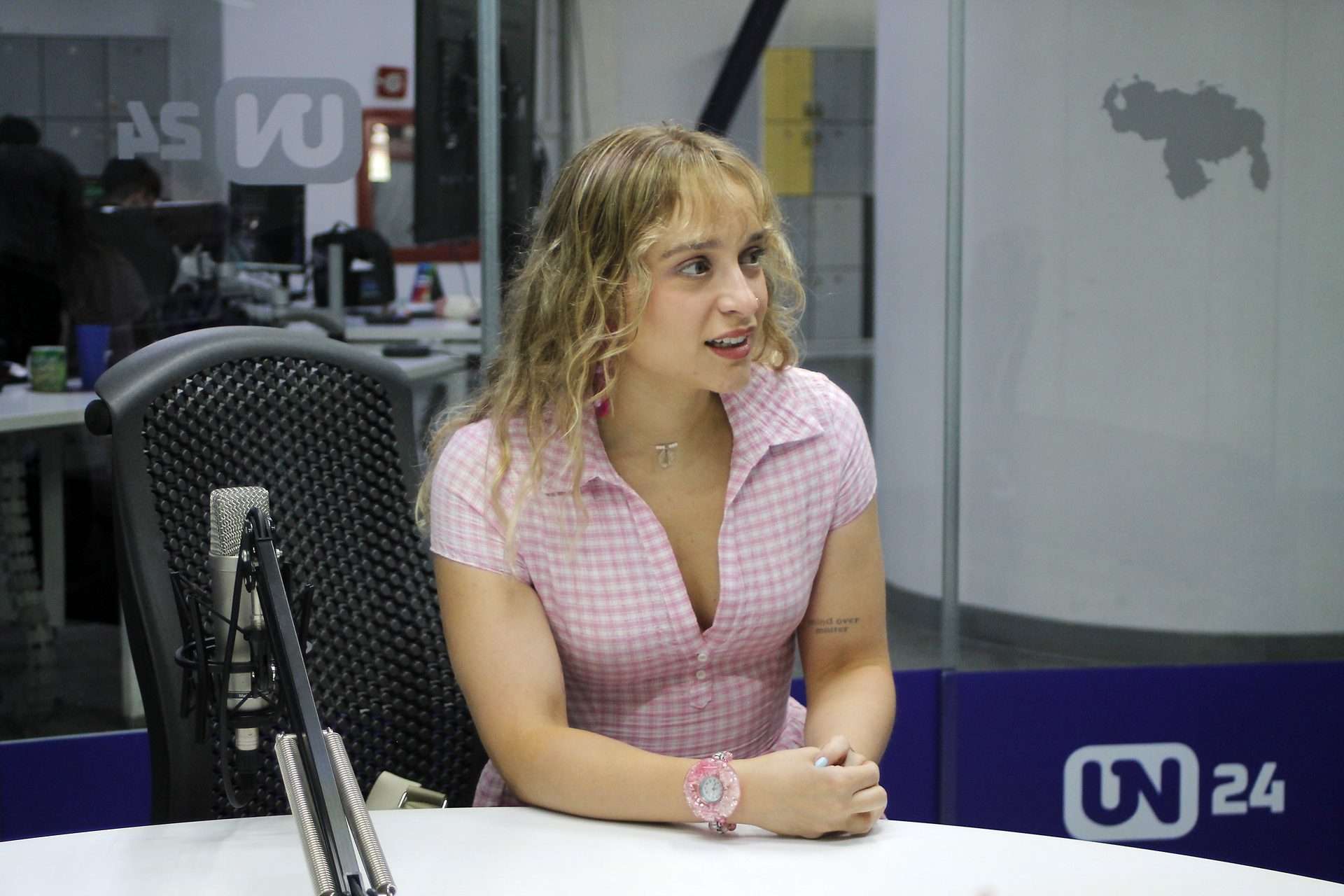
—What can you tell us about the EP you're preparing?
—This would be like the first EP I'm going to release, because last year I released a 10-song album, 'Una fiesta al desorden' (A Party in Disorder). So, this would be a second release, but in EP format and not an LP. Okay. I chose this format because I've been working on other songs, and there were a handful of them that found a home, meaning they all had the same feel and the same sound, like they blend together really well in terms of sound. It was an aesthetic decision, 100%, it's an aesthetic decision. And it's a decision, let's say, at an industry level, kind of strategic and aesthetic. But that doesn't mean there isn't a story behind all those songs that are intertwined. Oh, and loneliness, as I was saying, me being melancholic and nostalgic par excellence, is like my recurring theme. I'm there, and I think there are still things I have to say. I think we talk about love, about heartbreak, but what about those uncomfortable emotions and those emotions that refer to oneself and one's internal processes? I think it's wonderful to be able to address them and perhaps even accompany someone.
—Your biggest artistic dream?
—I have so many. I think I'm a very dreamy person, and I dream about quite a few things. One dream I'd really love to fulfill? To collaborate with Milo J, because I love his music. He's a reference point for our generation and for the kind of music I like to make. And everything is so ephemeral now. Something becomes trendy on TikTok, and the next day there's another trend, and the next day there's another one. I'm more looking for, perhaps, a community that enjoys and can accompany the process, which is what happens to me when I listen to Natalia (Lafourcade), Silvana Estrada, or Julieta Venegas—it doesn't matter if the song is new or old, it makes you feel something.