

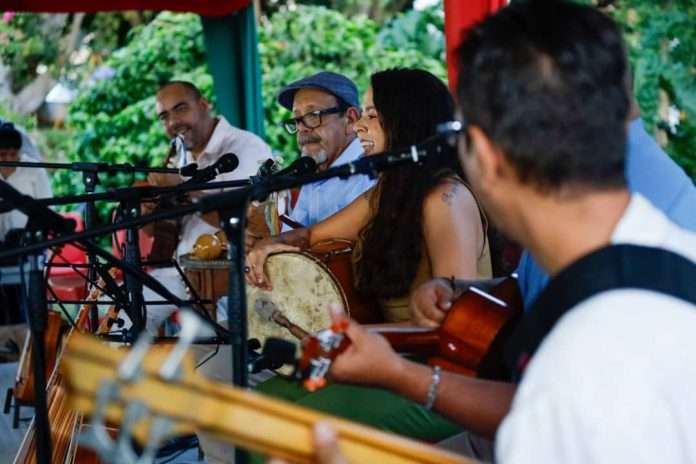
One of Ismael Querales's most cherished projects was promoting the repertoire of 19th-century songs compiled and harmonized by Vicente Emilio Sojo and recorded and popularized by his father, Teo Capriles. I remember his enthusiasm in 2012 for the concert with the Caracas Marching Band, where he sang several pieces from that repertoire in Teo's distinctive style. A truly sublime moment, which speaks to Ismael's dedication to sharing his love for our culture, was when his four daughters performed "La Valencianita" with boundless tenderness, featuring solos by his youngest daughters, Isabella and Ligia Elena, who, as adults, have also embarked on this artistic path. His other daughters, Marisela and Amanda, also inherited Ismael's artistic talent.
Considered a son of his teachers—and I'm talking about people of the caliber of Juan Esteban García, the great interpreter of the central bandola—Ismael was also a father to his students. From the workshops he taught at the Bigott school emerged the Zaranda group, directed by maestro Daniel Gil and made up of talented children like the brothers Javier and Pedro Marín, Leo Vargas, Ronald Chacón, and the older Querales sisters. The brotherhood that exists among these young people is, thanks to Ismael, as creative as it is unbreakable.
That affectionate quality he practiced, far removed from any competitive drive, allowed him to build bonds that extended beyond the professional sphere. With important groups like Los Golperos de Don Pío and La Verde Clarita, as well as with cultural figures like the beloved Guanarito horseman Vidal Colmenares, he forged unbreakable family ties. Let's continue.
Correction: In the previous installment, I mistakenly identified Florentino as the eldest of the Querales family; he is actually the faggot. My apologies.


